


'/%3E%3Cpath%20fill='%23b2b2b2'%20d='M241%20382q0%2016%2017%2026%2017%2011%2042%2011t42-11q16-11%2017-26V269H241'/%3E%3Cpath%20fill='%239f7e00'%20d='M241%20379q0%2014%208%2023%209%209%2021%209%2014%200%2021-9%209-9%209-23V269h-59'/%3E%3Cpath%20d='M241%20339v-70h59v110q0%2014-9%2023l-6%205v-68h-15v72q-8%200-14-4v-68zm59%2040c0%2022%2015%2032%2029%2032%2021%200%2030-18%2030-32v-40h-59'/%3E%3Cpath%20fill='%239f7e00'%20d='M266%20277v5h2v12h-3v-5h2v-5h-9v5h2v5h-4v9h3v18h-5v10h34v-10h-5v-18h3v-9h-4v-5h2v-5h-9v5h2v5h-3v-12h2v-5zm42%20101q0%2010%206%2017%206%206%2015%207%2010-1%2016-7%206-7%206-17v-29h-43'/%3E%3Ccircle%20fill='%230044ad'%20cx='329.5'%20cy='372'%20r='6'/%3E%3Cellipse%20fill='%230044ad'%20cx='300'%20cy='340'%20rx='16'%20ry='21'/%3E%3C/svg%3E)

'/%3E%3C/svg%3E)
Firewood Conveyor Belts
Stop picking wood from the ground: turn your toil into a continuous stream of profit.
Having a lightning-fast log splitter is useless if you spend half the day moving logs by hand because you run out of space. It’s the classic job done twice: the wood falls to the ground, you pick it up and load it.
Basically, you work twice as hard and earn half as much. With the wood conveyor belt, you eliminate this unnecessary step.
The wood comes out of the machine and lands straight on the truck, already cleaned of dirt and splinters.
You finish the load in half the time, saving your workers’ backs and, most importantly, you no longer have to stop every ten minutes to clear the yard.
Why you should consider a wood conveyor belt for your business
We know that your work is made of precision and sweat. But often, just as you try to accelerate, invisible obstacles emerge that eat into your profits and wear down your business. If managing firewood feels like a constant battle against time, you’ve probably fallen into one of these 5 traps.
❌ 1. If you break your back, you don’t have a spare one
❌ 1. If you break your back, you don’t have a spare one
Moving and handling tons of wood every day isn’t just tiring: it’s a poorly calculated risk.
An accident doesn’t just stop one person, it stops the entire company.
Choosing automation isn’t just about buying a machine; it’s about ensuring your work will continue tomorrow, without chronic pain or unexpected absences.
❌ 2. There’s no point in having a fast log splitter if the wood then remains still in the yard
❌ 2. There’s no point in having a fast log splitter if the wood then remains still in the yard
It’s a contradiction: you spent thousands of euros on a log splitter that runs incredibly fast, but then you have to turn it off every ten minutes because you don’t know where to put the wood.
You find yourself breaking your back clearing the logs by hand while the machine remains stationary.
You’re essentially working for the machine, instead of having it work for you.
If the load stops because the unloading area is full, the speed of the log splitter is useless: you’re just wasting time and fuel.
With a conveyor belt, however, the wood disappears as soon as it’s cut and ends up straight on the truck, and you keep splitting and the yard stays clear.
❌ 3. Stop paying someone to move your firewood empty
❌ 3. Stop paying someone to move your firewood empty
In a market where margins are razor-thin, employing a person just to collect firewood from the ground is an unsustainable living cost.
That worker is eroding your profit on every single quintal of firewood sold.
Automation transforms that ineffective fixed cost into an investment in a seamless process that pays for itself quickly.
❌ 4. Nobody wants to buy wood that’s covered in mud
❌ 4. Nobody wants to buy wood that’s covered in mud
When wood falls to the ground, it collects stones, dirt, and moisture.
For a demanding customer, this means dirt; for you, it means ruining your brand’s reputation.
Furthermore, if a sudden storm arrives, the wood on the ground becomes heavy and unsellable.
A conveyor belt carries it directly indoors: clean, dry, and ready for delivery.
❌ 5. Stop moving the same wood twice
❌ 5. Stop moving the same wood twice
Without a direct unloading system, you handle the same piece of wood at least twice: first to split it, then to load it onto the trailer.
This inefficiency doubles loading times without adding a cent of value to your product.
Eliminating unnecessary steps means one thing: getting home on time and protecting your profit.
Stop wasting time and effort on a mountain of wood that grows out of control.
With the right conveyor belt, your yard stays tidy and you can load trucks without even noticing.
No need to complicate your life with endless manual movements: choose a system that keeps pace with your production and see the difference immediately.
Find the perfect solution for your production, in one click!
How to turn a firewood conveyor belt into a production-augmenting tool
Forget the chaos of piled up wood and the stress of forced emergency stops.
We’ll help you find a solution that transforms manual labor into a continuous flow of work, protecting your margins and the health of you and your team.
✅ 01. Increase your productivity without adding more workers
✅ 01. Increase your productivity without adding more workers
Paying two or three people just to pass logs by hand is a stupid way to waste money.
Every hour your men spend making the chain to move the wood is time you’re paying for.
With a conveyor belt, just one person does the work of three.
This means that while the machine loads, the others can do other things or you can simply save on salaries.
It’s a solution that reduces your operating costs and lets you regain control of your margin and your profits: the conveyor belt never tires and never stops.
✅ 02. No more accumulations and downtime: the wood comes out as quickly as you produce it
✅ 02. No more accumulations and downtime: the wood comes out as quickly as you produce it
The real cost of a plant lies in machine downtime.
With a handling system, you create a link that synchronises the wood cutting speed with storage.
No more piles and stacks to clear or congested areas: the whole process flows smoothly, allowing you to maximise hourly output without peaks in workload.
✅ 03. Don’t wait until someone has back pain to change your approach
✅ 03. Don’t wait until someone has back pain to change your approach
Handling tons of wood doesn’t have to end with a sore back—or worse.
There’s no point in risking injury when you can let the conveyor belt do the heavy lifting.
By keeping people away from where the logs are falling, you avoid silly accidents that shut down the yard for days.
Safety isn’t just a buzzword: it simply means that tomorrow morning, you’ll all be back at work, injury-free and on schedule.
✅ 04. It works where you need it, not just on concrete
✅ 04. It works where you need it, not just on concrete
Mud, snow, or steep slopes won’t stop you anymore.
The structure is designed to stay put wherever you place it, allowing you to load trucks or stack wood so high that you couldn’t even dream of doing it by hand.
Instead of struggling with the terrain or the effort of lifting logs, let the conveyor belt carry them up.
It’s a way to bypass the chaos of the worksite and get the wood exactly where you need it, without taking a single extra step.
✅ 05. Sort your trash as you load it, so you don’t have to waste time later
✅ 05. Sort your trash as you load it, so you don’t have to waste time later
No one likes unloading a load of wood from a customer and leaving behind an inch of dirt, debris, and splinters to sweep up.
If you make a mess, they’ll probably call someone else next time.
That’s why you should consider grids: as the conveyor belt runs, the vibrations shake the logs and knock all the dirt to the ground before it ends up in the truck.
That way, what you deliver is clean, and you don’t have to waste half an hour cleaning up by hand every time.
Load, unload, and you’re done—without anyone complaining.
Let’s find the right firewood conveyor belt for you: choose the right model for your work!
Every minute of downtime isn’t just an inconvenience, it’s a ruined day. That’s why choosing the right conveyor belt is a way to protect your investment and optimize your workflow.
Discover the features to consider:
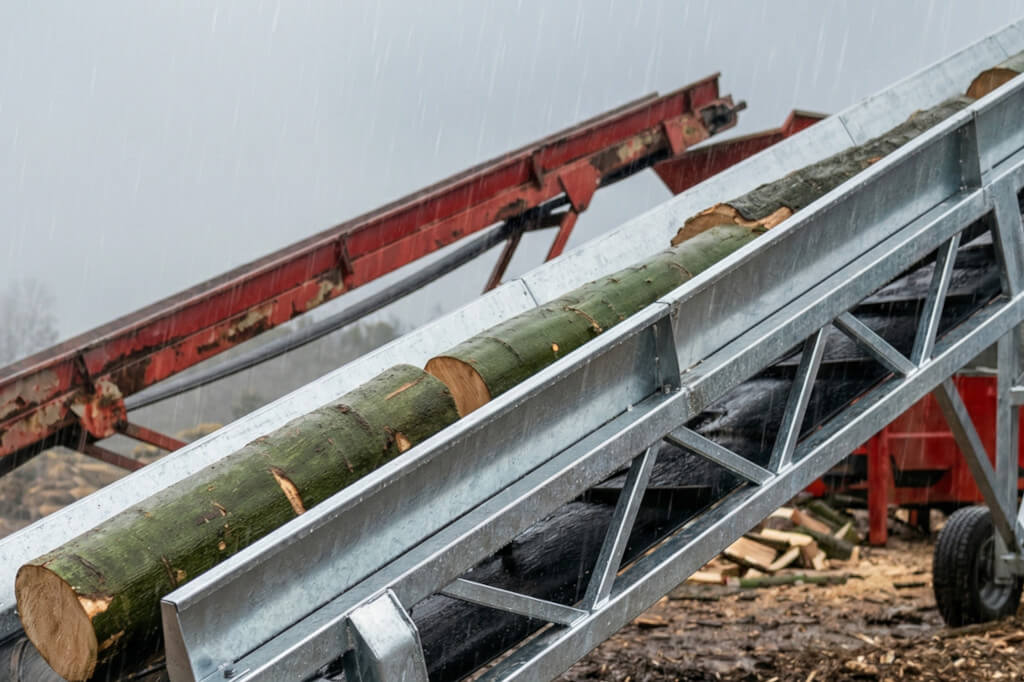
1. Hot-dip galvanizing for true outdoor durability
Between mud, rain, and the dampness of green wood, a painted firewood conveyor belt will quickly begin to peel and rust.
This is why it’s important to choose a fully hot-dip galvanized trellis structure: the metal is protected everywhere, even in the corners where water stagnates.
You can leave a machine like this outside in the rain or snow without worrying about it rotting, and if you decide to sell it tomorrow, it will still be in good condition and rust-free.
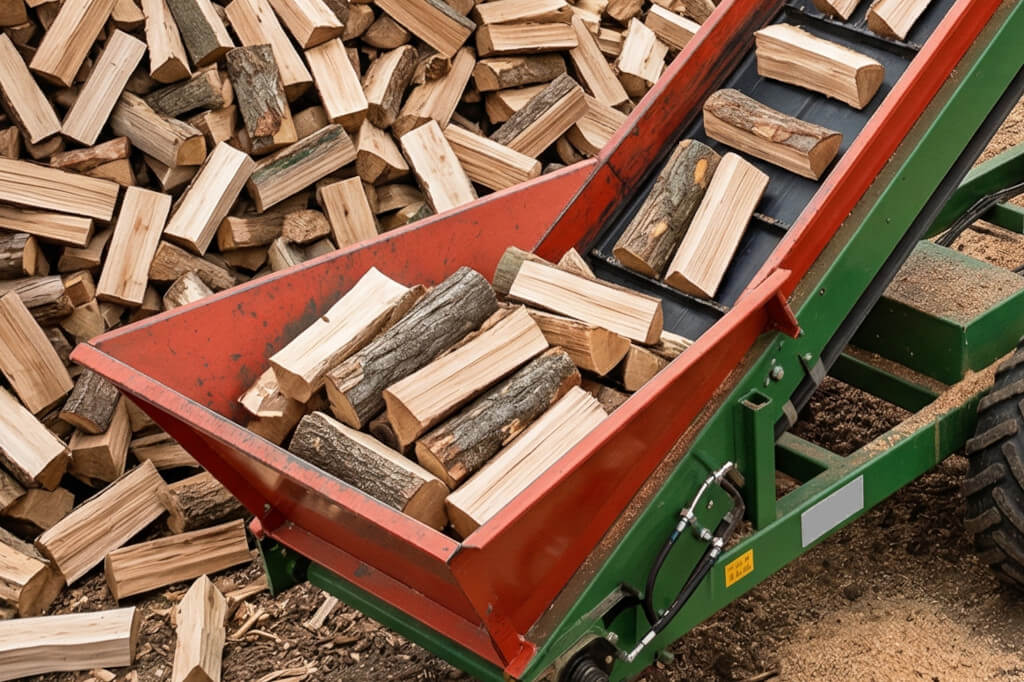
2. Hopper made to last, even if the log splitter unloads large and heavy pieces
When the logs come out of the log splitter, they forcefully hit the structure.
If the hopper is lightweight, after a month it’s completely dented and the wood starts to get stuck, forcing you to stop to unclog it.
Choose one with thick sheet metal, specifically designed to withstand the impacts without warping.
This way, you don’t have to worry about anything falling on it and, above all, you don’t have to waste days straightening the iron or welding cracks that shouldn’t be there.
The firewood conveyor belt must be able to work consistently and not need repairs every Monday.
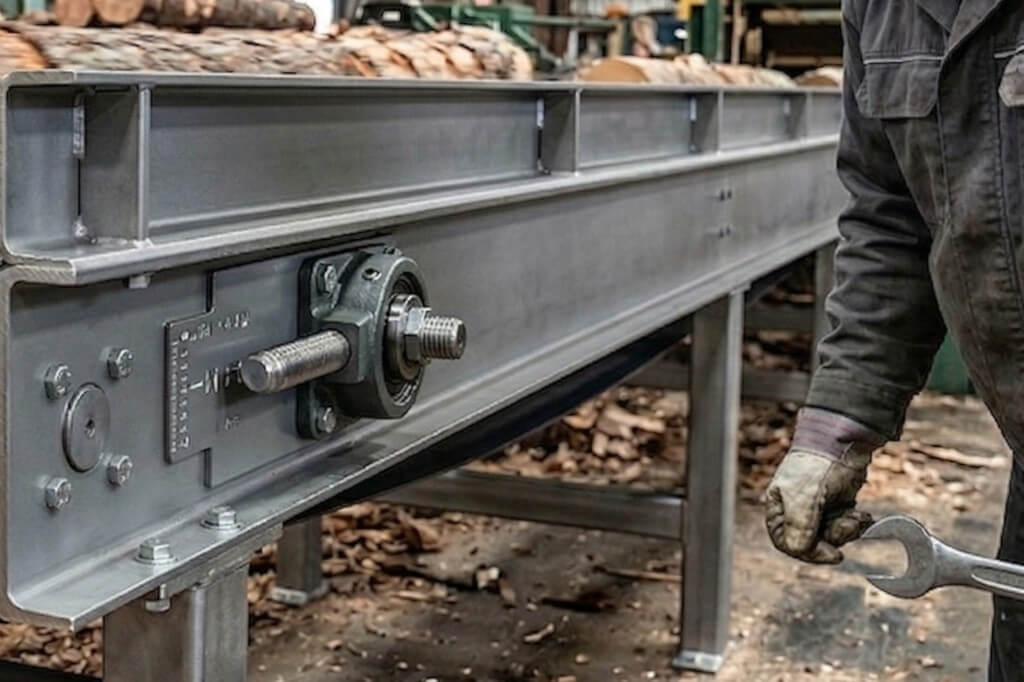
3. Quick adjustment: pull the tape in an instant and get back to work
There’s nothing more frustrating than a belt that starts slipping just when you have a truck to finish.
Between the cold and heavy loads, it’s normal for the belt to come loose from time to time.
The problem is that on many machines, you have to go crazy removing covers and guards just to get to the tensioner.
Choose a machine with the tensioner on the outside and within easy reach: all it takes is a wrench and two minutes to center and tension the belt.
You don’t have to disassemble anything and you don’t waste time. You stop, tighten the screw a couple of times, and get going again, without being left stranded just when you have the most work to do.
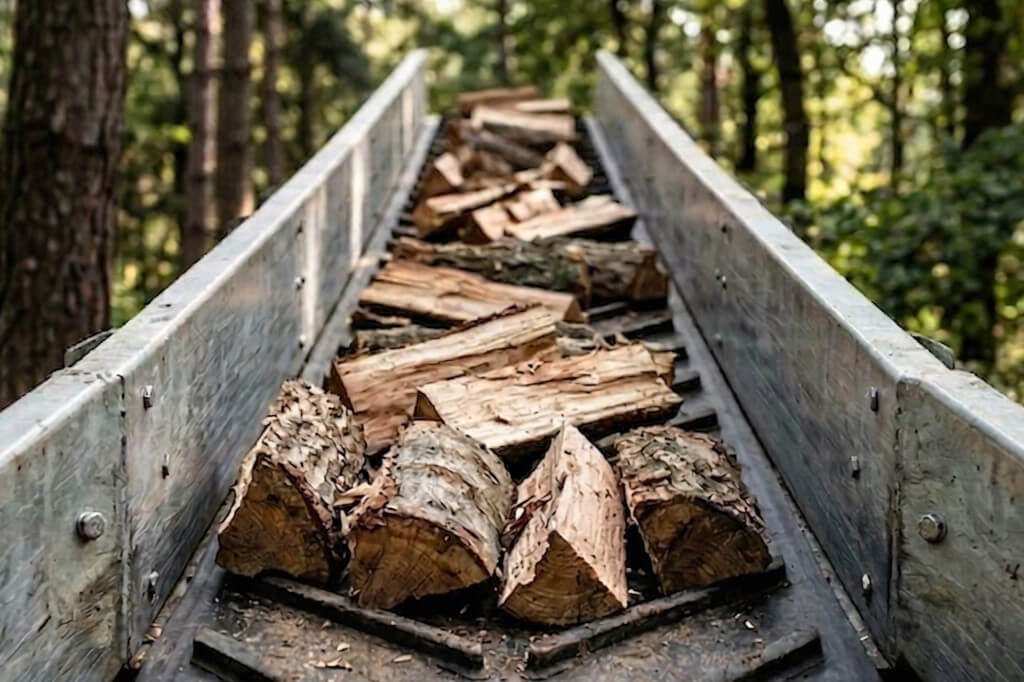
4. More slope, less clutter: the rubber keeps the logs planted on the belt
Picture yourself raising your firewood conveyor belt to load a trailer, only to watch the logs slide right back down because the belt can’t get a grip.
Wood is never perfectly straight, and bark is slick—especially when wet.
If your cleats are made of flimsy plastic or just bolted on, they’re eventually going to bend or snap off.
That’s why you should choose a belt with vulcanized rubber cleats, where the cleats and the belt are molded as a single, solid piece.
This means you can crank the incline past 30 degrees and the wood stays put, locked in until it drops into the truck.
Stop worrying about adjusting the angle every five minutes or watching logs slide backward: just turn it on, load it up, and let the belt haul everything without a second thought.
Summary of Firewood Belt Conveyor Features: Market Technical Standards
Every firewood conveyor can feature different specifications depending on the manufacturer and the end-user’s requirements.
However, it is essential to analyze what is currently available on the market to identify common components and, consequently, the industry reference standards.
There is no one-size-fits-all model, but the right one for your specific operation does exist: with conveyorbelt.it, we help you find the custom conveyor tailored to your needs!
| Technical Specification | Value |
|---|---|
| Power Supply | Hydraulic via tractor hydraulics / 220 V Single-phase electric / 380 V Three-phase electric |
| Length | From 3 m to 8 m |
| Width | From 300 mm to 600 mm |
| Maximum height | From 2.4 m to 6 m |
| Belt Material | Various materials, primarily PVC or rubber |
| Cleats or Flights | Rubber or metallic, fixed or removable |
| Dual Power Supply | Dual-power management systems available |
| Adjustable Height | Systems available to adjust height and incline with clutch and automatic brakes |
| Adjustable Speed | Speed control systems available |
| Adjustable Belt Tension | Belt tensioning systems available |
| Feed Hopper | Large-capacity, detachable or fixed |
| Tow Bar | Detachable or fixed |
| Wheels | Suitable for transport on uneven ground and rough terrain |
| Accessories | Bark cleaning grate, swivel undercarriages |
| Customization | Tailored custom-built solutions or configurable base models available |
Criteria for choosing the best firewood conveyor belt: How do you find the right one?
When looking for a firewood conveyor belt for your business, there are many factors to consider, so we’ve compiled the main questions you might want to explore.
Obviously, the larger the investment for your business, the more you’ll want to be certain that the machine you choose is the right one and best suited to help you improve your results.
Here is a list of the key factors to consider to help you choose the right machine for your needs:
- What is a firewood conveyor belt? Find out here what kind of machine it is!
- What types of power supply are there for a firewood conveyor belt? Find out how it works here!
- How is a firewood conveyor belt made and what types of components are there? Find out how it’s made here!
What is a firewood conveyor belt: how to stop working twice as hard and earning half as much
A firewood conveyor belt is a mechanical system that takes the freshly cut log or log and delivers it exactly where you need it, allowing you to use the height to fill trailers or create huge piles without you having to lift a finger.
If you cut wood and don’t have a conveyor belt, you’re doing the job twice.
Every log that comes out of the log splitter and falls to the ground costs money, because someone will have to bend down to pick it up and load it onto the truck or put it in a crate.
How a firewood conveyor belt works: how to avoid shutting down your business
The best firewood conveyor belt for your business and your needs is the one that best adapts to your workplace, becoming a valuable aid in optimizing your processes.
The first and most crucial aspect is the power supply, which allows you to work wherever and however you want.
Not all yards are the same, and in the woods you don’t have power outlets, so the belt’s operation must adapt to your location, not the other way around.
The main power sources you can consider are:
- Hydraulic firewood conveyor belts: These are the ideal solution for those who need a conveyor powered by a tractor or other machinery equipped with hydraulic remotes, making them perfect for use in forests or rugged terrain. Additionally, standalone gas or electric hydraulic power units are available on the market, allowing these conveyors to be used in various other settings.
- Gas-powered firewood conveyor belts: This is the right choice for those seeking total independence from other machinery. They offer complete autonomy and flexibility for working in challenging environments.
- Electric firewood conveyor belts: They are the perfect solution for those working in warehouses, yards, or in areas with access to an electrical outlet or similar power source. There are two types:
- Single-phase electric firewood conveyor belts: Ppowered by 230 volts, these are designed for occasional, light-duty use and are typically found on shorter models. They are the ideal choice for domestic use or intermittent tasks.
- Three-phase electric firewood conveyor belts: Powered by 400V, these are built for intensive, heavy-duty use and for longer models (such as 23–26 feet). They are the go-to solution for professional operations and continuous workloads.
What makes up a firewood conveyor: best models available on the market
When selecting the best firewood conveyor belt for your business, you need to evaluate various design aspects and the components chosen for its configuration.
Here are the key factors to consider:
- Frame: It shouldn’t just support the weight, but also absorb vibrations and be designed to withstand outdoor use and varying weather conditions. For a firewood conveyor belt, a hot-dip galvanized steel structure or a powder-coated finish is preferred to resist the elements, prevent scratches, and better handle wear and tear. Stability also plays a key role in preventing tipping; depending on the conveyor’s length at maximum extension, it is crucial to have a sufficiently wide base and/or stabilizing feet.
- Conveyor belt: Choosing the right material makes all the difference in the world when it comes to reducing downtime and operational issues. Options range from reinforced PVC belts for light-duty use to multi-ply rubber belts designed to withstand the impact of heavy logs. The cleats (rubber or metal paddles) also play a fundamental role; their job is to grip and haul the logs to prevent them from sliding backward, depending on both the incline and the material used. There are different types of cleats available, such as those made of vulcanized rubber or metal. Furthermore, they can be molded as a single piece with the belt (integrated) or bolted on.
- Power system: his is a crucial aspect that shouldn’t be overlooked, as it allows you to use your firewood conveyor belt in various settings. The main options include hydraulic systems connectable to tractors and machinery, single-phase or three-phase electric systems, and gas-powered engines. For more information, please read the previous section where you will find all the detailed information.
- Elevation System: Being able to raise and lower the conveyor can be a key factor if you need to constantly adjust it to load wood into trucks of different heights. It’s important to know that there are hydraulic systems powered by a cylinder, as well as manual systems that require more effort and “elbow grease”.
- Additional Components: The right add-on can significantly streamline and speed up your workflow. Key features to consider include the hopper, which can collect logs directly from a saw, for example, and the discharge grate (or debris screen), which allows you to shake off the bulk of the dirt and debris while the wood is being moved.
- Mobility system: Depending on your intended use, the type of tires becomes a key factor; you should prioritize pneumatic tires that can handle forest floors or muddy terrain. Additionally, you might want to consider a telescoping or folding design if you need to adjust it for different lengths or if you frequently move it from one location to another.