


Food Industry Conveyor Belts
No more unsuitable materials and unexpected downtime. Your production deserves a continuous flow!
Having dosing machines, ovens, or packaging machines running at high speeds is completely useless if the line then stops because the belt failed due to the attack of fats, oils, or acids, or because the dough keeps sticking to the surface, forcing operators into continuous manual stops.
It is the paradox of the food industry: you invest in state-of-the-art technological systems, but then you pay staff to spend hours disassembling, scraping, and sanitizing unsuitable components, turning your profit margins into hours of unplanned line downtime.
With the correct food conveyor belt for your specific recipe and temperature range, the product flows smoothly and steadily: zero liquid absorption, zero residues trapped in the splices, and washdown cycles cut in half.
Maintain a consistent pace throughout the entire shift, drastically reduce the risk of contamination, and, above all, you will no longer have to halt packaging halfway through the day due to a belt that is slipping or fraying.
Why consider a food conveyor belt for your business
In manufacturing and the food industry, a conveyor belt is never just a simple mechanical sliding element: it is the infrastructure upon which your facility’s entire operational continuity relies.
When the material, tension, or structure are not calibrated to the millimeter for your specific process, initial savings vanish instantly: they turn into unplanned downtime, wasted hours disassembling guards, and the constant uncertainty of not being truly protected.
Here are the 5 pitfalls to avoid every day:
❌ 1. The nightmare of a health inspection with invisible residues and penalties just around the corner
❌ 1. The nightmare of a health inspection with invisible residues and penalties just around the corner
A microporosity in the compound, a frayed splice, or a hard-to-reach blind spot is enough to turn the line into a bacterial breeding ground.
Working with the anxiety of the next swab test or HACCP audit means producing under constant pressure.
The real risk is not merely an administrative fine: what is at stake is the blocking of entire production batches, immediate commercial penalties, and company credibility built over decades of hard work.
❌ 2. Sudden line downtime with the line going silent, hourly costs skyrocket
❌ 2. Sudden line downtime with the line going silent, hourly costs skyrocket
The dull thud of the belt mistracking, the motor under thermal strain, the line suddenly grinding to a halt right in the middle of the shift.
Every quarter of an hour spent manually readjusting the tracking or waiting for an emergency spare part destroys your hourly schedule and sparks friction between maintenance and management.
Maintenance should not be a desperate race against the clock: your line deserves stable and reliable components over the long term.
❌ 3. Exhausting sanitization and washdown hours eating away at your operating margins
❌ 3. Exhausting sanitization and washdown hours eating away at your operating margins
Every hour your operators spend disassembling guides, return rollers, and guards to remove stubborn residues is time taken away from actual production.
Belts that are difficult to sanitize do not just multiply expenses for harsh chemical detergents and cubic meters of water: they waste skilled labor on low-value tasks, turning every recipe changeover or routine sanitization into a financial drain on company margins.
❌ 4. The silent threat of fragments with wear that escapes metal detectors
❌ 4. The silent threat of fragments with wear that escapes metal detectors
There is an invisible danger that keeps food manufacturers awake at night: the micro-fragmentation or progressive delamination of the belt in direct contact with the product.
Uncalibrated polymers degrade over time, releasing micro-particles that standard inspection systems cannot always detect.
A single foreign body reaching store shelves triggers mass returns, legal disputes from large-scale retailers, and irreparable reputational damage to the brand.
❌ 5. Misaligned flows and the “accordion effect” with disorder throttling throughput
❌ 5. Misaligned flows and the “accordion effect” with disorder throttling throughput
When the forming, cooling, and packaging stations do not advance at a harmonious pace, a bottleneck is inevitable.
Disorderly accumulation forces upstream machines to slow down and downstream operators to scramble to keep up with the workload, resulting in damaged packages or bunched-up trays.
Without conveyors engineered to synchronize and buffer the flow with millimeter precision, even the most advanced machinery ends up running at half its actual capacity.
Your production line does not need just any belt. It needs the exact solution for your process.
Do not risk machine downtime and do not waste weeks sifting through dozens of generic catalogs.
Find the right belt for your facility, in just one click!
How a food conveyor belt can become an ally for your production
Food industry conveyor belts are not mere spare parts, but solutions for the operational continuity of your facility and line.
With the right belt, you eliminate the anxiety of inspections, clear bottlenecks, and bring production up to your desired pace.
Choosing the correct belt does not mean flipping through endless catalogs hoping it will work.
It means integrating into your plant a certified, custom-engineered solution designed to protect your margins and allow you to work with complete peace of mind.
✅ 01. MOCA and FDA certification to face health inspections with total confidence
✅ 01. MOCA and FDA certification to face health inspections with total confidence
Food safety leaves no room for error.
The selected belts are made exclusively from closed-pore materials compliant with European MOCA and international FDA standards.
They prevent bacterial proliferation, eliminate the risk of cross-contamination between batches, and come complete with comprehensive technical data sheets.
You face any inspection with the certainty of being fully compliant.
✅ 02. Multiply hourly throughput within the same footprint with a continuous flow
✅ 02. Multiply hourly throughput within the same footprint with a continuous flow
No more manual handling steps and idle time between workstations.
By adjusting conveying speed with millimeter precision, the belt sets the ideal pace for the entire department: it coordinates machinery and operators, eliminates bottlenecks, and increases daily production capacity while preserving the quality of your artisan or industrial standards.
✅ 03. Total cleaning and sanitization in just a few minutes thanks to quick-release mechanisms
✅ 03. Total cleaning and sanitization in just a few minutes thanks to quick-release mechanisms
Recipe changeovers and end-of-shift washdowns should not paralyze your day.
Thanks to quick-release components, integrated scrapers, and sanitary guide rails removable by hand without tools, sanitization becomes immediate.
Fewer hours lost in routine maintenance, zero unjustified facility downtime.
✅ 04. Millimeter-precise synchronization for constant dialogue between machines
✅ 04. Millimeter-precise synchronization for constant dialogue between machines
An efficient food conveyor belt is the bridge connecting the entire line.
Engineered to interface with forming machines, ovens, dosing machines, and packaging machines, it ensures orderly transit in continuous motion or via dedicated sensors.
The result: zero jams, less unnecessary handling, and a harmonious flow from start to finish.
✅ 05. Intact product from the bench to packaging without scratches or damage
✅ 05. Intact product from the bench to packaging without scratches or damage
The care you put into processing deserves to reach the customer intact.
Smooth, jerk-free motion protects delicate decorations, filled pastries, and fragile surfaces from the impacts and deformations typical of manual transport on carts and trays.
You minimize scrap and protect the economic value of every single item.
Together, Let’s Find the Food Conveyor Belt You Need: For Those Who Cannot Afford Contamination, Errors, or Line Downtime!
In the food sector, a belt is more than just a mechanical component: it is the pulsating artery of production.
A minor setback—such as a misaligned loaded belt or sanitization performed improperly due to cleaning difficulties—is enough to ruin hours of work and completed production.
That is why it is essential to select the most suitable technical specifications to ensure certified hygiene, durability, and a continuous production flow.
Discover the key features to evaluate:
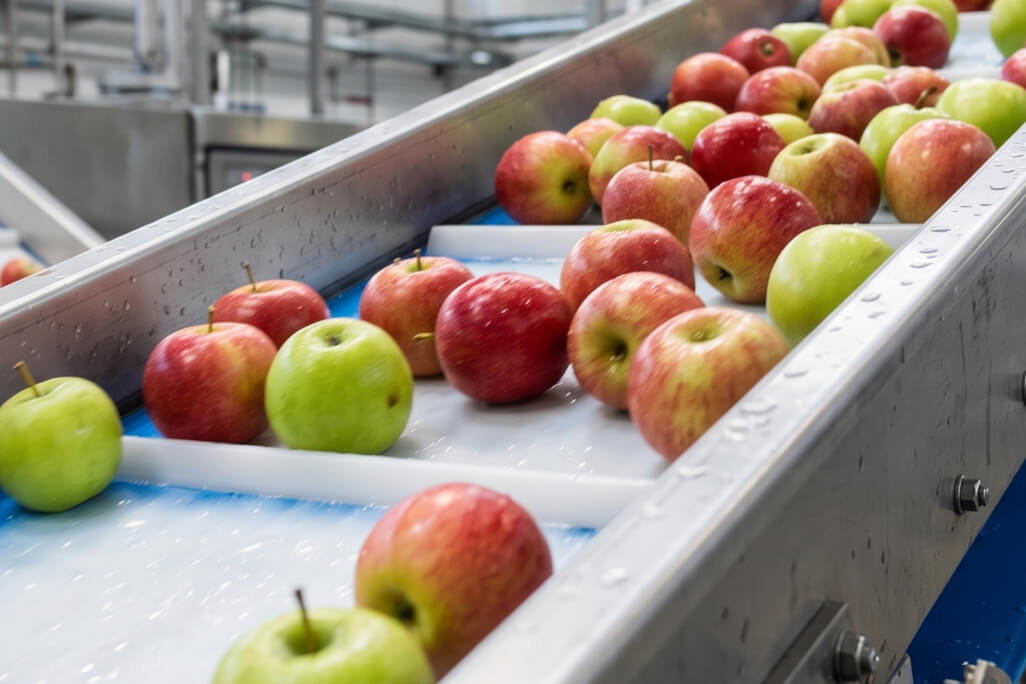
1. MOCA and FDA-certified belts: eliminate uncertainties during health inspections
In the food industry, it is crucial to protect your brand and operate in compliance with the law, making belt selection essential for direct food contact.
The right materials must be selected—whether based on polyurethane, silicone, or non-toxic, chemically inert plastic modules suited for food contact and the specific processing required.
It is imperative to guarantee zero particulate shedding onto raw and processed foods, as well as to receive the necessary compliance documentation and technical files to handle disputes and hygiene audits while avoiding fines or complications.
2. Materials and hygienic design: for deep cleaning in just a few minutes
The materials, structure, and layout of a food conveyor belt are aspects that make all the difference in achieving deep cleaning in just a few minutes.
During recipe changeovers or end-of-day washdowns, it is essential to save time and be able to perform a deep, detailed cleaning.
For the frame, for instance, it is best practice to use AISI 304 or AISI 316L stainless steel depending on the type of food and processing, continuous welds, and the absence of crevices, dead corners, or stagnation points.
Furthermore, quick-release and disassembly systems for various components can be integrated to allow full access and complete sanitization.
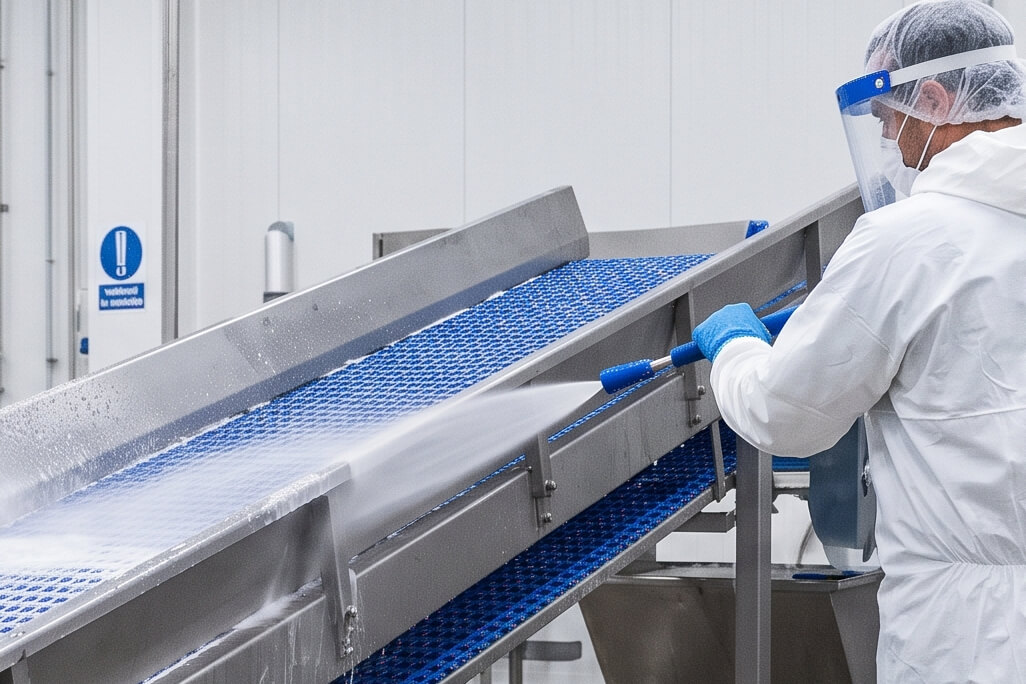
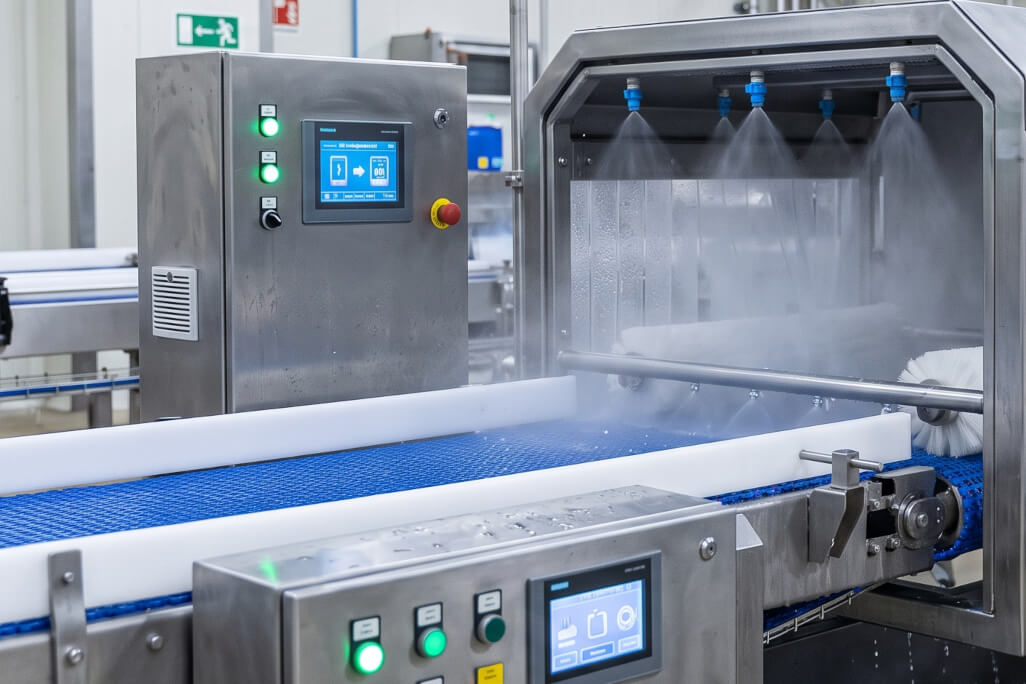
3. Sealed IP66 / IP69K Drive: resistance to high-pressure jets and harsh chemical cycles
When there is a need to wash down and sanitize with high-pressure water and harsh chemical detergents, the drive system and mechatronics must be protected.
With watertight sealing, you prevent short circuits, water ingress, and various post-wash alarms that shut down the line.
Having no exposed vulnerable components allows you to thoroughly wash the line with the complete peace of mind that it will restart immediately and operate safely.
4. Knife-edge transfer: smooth transition, zero bruising or cosmetic scrap for food products
The belt must have the objective of preserving the food product, whether a finished product or raw material, throughout the various processing stages.
This is why it is essential to protect the integrity of food items, even fragile ones, during conveying.
To achieve this, it must be engineered with dedicated transfer transitions and surfaces with a calibrated friction coefficient to enable smooth handovers, preventing sudden drops or jams.
With the right belt, it is possible to handle fresh dough, baked goods, fruit, and vegetables while preserving the end value of the product.
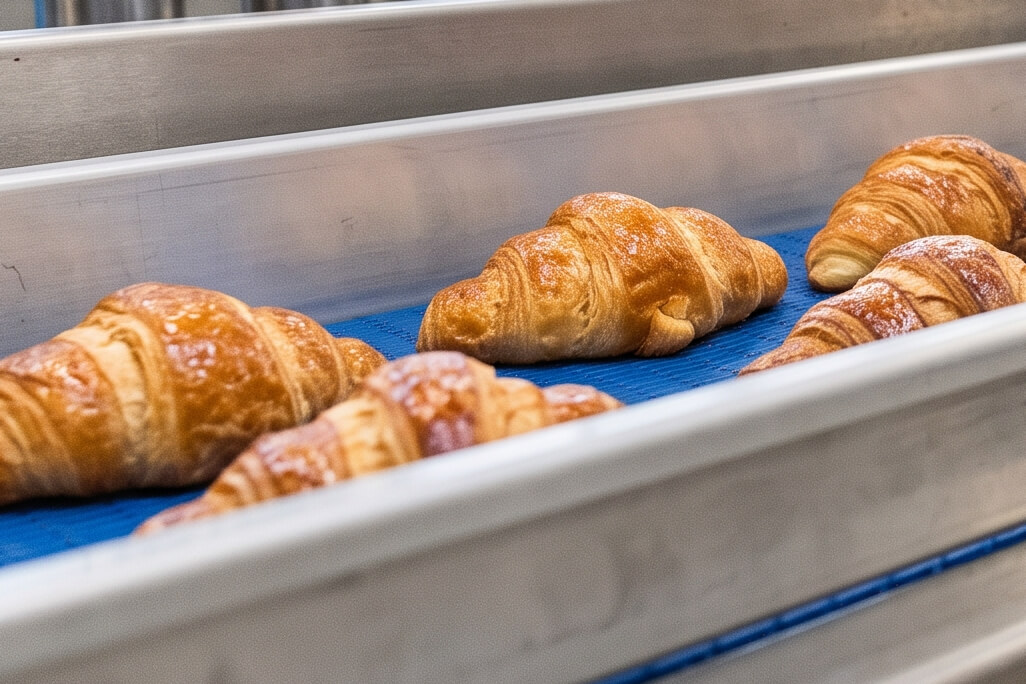
Criteria for finding the best food conveyor belt: how to find the most suitable one?
Selecting the right food conveyor belt for your production line, industry sector, and facility type requires evaluating numerous technical factors and details; therefore, we have compiled the main questions and considerations to explore.
Moreover, as the investment becomes more significant for your business, it becomes increasingly critical to ensure the selected machinery is the ideal fit to scale up and enhance production.
Below is a checklist to review and examine to help you navigate the world of conveyor belts and find the ideal solution for your needs:
- What regulations must a food conveyor belt comply with? Discover the appropriate certifications here!
- Which belt material should you choose? Find the most suitable belt for your needs here!
- Which frame material is best suited? Discover the right material for your facility here!
- Can a metal detector be integrated? Find out here if this is the right solution for you!
- What food products can a food industry conveyor belt handle? Explore the use cases here!
Hygiene regulations for food conveyor belts: which ones to consider and how to comply
Selecting the right solution among food industry conveyor belts for your facility certainly requires understanding in greater detail the full set of hygiene standards and food sector regulations that can impact your choice.
Below, you will find all the main regulations, laws, and technical standards that must be complied with for the design, construction, and commissioning of food industry machinery.
- European regulatory framework: primary among which is commonly known as “MOCA” (Food Contact Materials or FCM). Below are the main standards to consider:
- Regulation (EC) 1935/2004 – FCM/MOCA: this is the primary framework regulation establishing the general principle that food contact materials must not transfer their constituents into food in quantities that could endanger human health, bring about an unacceptable change in food composition, or alter organoleptic characteristics (taste, odor, color);
- Regulation (EU) 10/2011 – Plastic FCM: specifically targets plastic materials, including those utilized for conveyor belting. For example, it regulates TPU polyurethane, PE polyethylene, PP polypropylene, and food-grade PVC. It sets overall and specific migration limits, authorized substances, and testing conditions with food simulants;
- Regulation (EC) 2023/2006 – GMP: the acronym stands for Good Manufacturing Practice. While not exclusively limited to the food sector, it mandates that material manufacturing must adhere to good manufacturing practices supported by documented quality assurance and quality control systems throughout the entire production process;
- In summary: these standards define material suitability and ensure manufacturing processes comply with good manufacturing practices;
- United States regulatory framework: encompasses the regulations and standards administered by the FDA (Food and Drug Administration), applying to goods exported to the USA and broadly adopted as international benchmarks. Below are the key regulations to consider:
- FDA 21 CFR 177: part of the Code of Federal Regulations covering synthetic polymers such as rubbers, resins, coatings, elastomers, and plastics;
- FDA 21 CFR 178: part of the Code of Federal Regulations governing indirect food additives, including adjuvants, lubricants, and processing aids;
- In summary: these regulations verify that all raw materials, polymers, and additives used for the food conveyor belt in direct food contact are included in FDA positive lists and are safe for food contact;
- Common technical directives and standards: this category compiles stringent requirements for sanitation and hygienic design. Below are the primary standards to consider:
- UNI EN 1672-2: a European standard on the hygienic design of food machinery defining three distinct hygiene zones (food area, splash area, and non-food area);
- EHEDG / 3-A Sanitary Standards: EHEDG stands for the European Hygienic Engineering & Design Group; these represent international benchmarks for advanced hygienic engineering. They particularly emphasize CIP/COP cleanability, continuous welds, and materials resistant to harsh detergents and disinfectants;
- Machinery Directive 2006/42/EC and Machinery Regulation (EU) 2023/1230: include, among their annexes, the Essential Health and Safety Requirements specifically dedicated to food industry machinery—notably requiring smooth surfaces, no blind spots, easy cleanability, and proper drainage to eliminate stagnation points and bacterial proliferation;
- HACCP Regulation (EC) 852/2004 / ISO 22000 / FSSC 22000: these encompass food safety management standards requiring hazard analysis and critical control point monitoring associated with conveying food along the processing line;
Which material to choose for the food conveyor belt: find the most suitable one for your needs
When selecting the right belt for a food conveyor belt, close attention must be paid not only to hygiene standards, but also to the specific type of food product and the processing stages involved.
Materials exhibit differing mechanical and abrasion resistance, varying non-stick release properties, and vastly different thermal resistance limits.
Selecting the proper belt for your facility and specific application is vital for production success and to avoid complications that cannot easily be resolved once the line is running.
Let us examine the main alternatives available:
- PU / TPU Polyurethane: features properties such as cut resistance, abrasion resistance, and imperviousness to vegetable oils and animal fats, while remaining non-porous. It represents the primary choice for meat, poultry, fish, dairy, and oily bakery products. It withstands heavy loads, accidental cuts, and the degrading effects of animal fats. However, it can be susceptible to steam and prolonged hydrolysis at high temperatures unless formulated with specific hydrolysis-resistant additives. Typical applications include:
- Slaughterhouses;
- Cured meat processing plants;
- Dairies;
- Fish processing facilities;
- TPO / PE Polyolefins: deliver superior non-stick release properties, are chemically inert, moisture-resistant, and entirely plasticizer-free. They provide lower cut resistance compared to TPU polyurethane and are not suitable for high-temperature ovens. They are the premier choice for raw sweet and savory doughs, fresh cheese processing, and sticky room-temperature products. Typical applications include:
- Industrial bakeries;
- Biscuit and cookie manufacturing;
- Commercial pastry production;
- FDA / EU Certified Food-Grade PVC: was widely utilized in the past for its cost-effectiveness; today, however, it must be strictly phthalate-free. Consequently, TPO polyolefin is frequently preferred in applications where compliance must remain streamlined. Overall, it offers an excellent price-to-performance ratio, is water-repellent, and resists mild acids and gentle washdowns. It carries a risk of plasticizer migration when exposed to free fats and oils (hence the requirement for phthalate-free grades) and features low resistance to direct cutting. It is the primary choice for sorting and washing firm-skinned, non-oily fruit and vegetables (such as potatoes, apples, and citrus), as well as root vegetables, grains, rice, dried legumes, and packaging lines. Typical applications include:
- Fruit and vegetable processing;
- Grain mills;
- End-of-line systems;
- Food packaging;
- Silicone: provides exceptional release properties and an extensive operating temperature range from approximately -40°C up to +180°C / +200°C. It exhibits low mechanical resistance to cuts and punctures and is unsuitable for use with rigid metal scrapers or direct knife portioning on the belt. It represents the primary choice for hot sugary products, gummy candies, poured or melted chocolate, and toffees. Typical applications include:
- Oven infeed/outfeed sections;
- Chocolate manufacturing;
- Confectionery plants;
- PE Modular Belting: is flexible, resistant to extreme cold down to approximately -70°C, and offers a low coefficient of friction. It is not suitable for high temperatures as it softens above 65°C. It is the primary choice for ice cream handling, fish packed with ice flakes, and Individual Quick Freezing (IQF) tunnels. Typical applications include:
- Frozen foods;
- Blast chillers and freezers;
- Sub-zero cold storage;
- Frozen seafood processing;
- PP Modular Belting: is heat-resistant up to +100°C and demonstrates superior resistance to acids, bases, and aggressive CIP chemicals. It is unsuitable for sub-zero temperatures where it turns brittle and rigid. It is the primary choice for vegetable blanching, pasteurization processes, and hot washing or cooling tanks. Typical applications include:
- Canning and preserves;
- Ready meals;
- Fresh-cut (IV range) and precooked (V range) produce;
- AISI 304 / 316 Stainless Steel Wire Mesh Belting: withstands extreme temperatures, is completely non-combustible, and its open woven structure provides complete liquid drainage. Given its substantial self-weight, it requires dedicated frame components and drive engineering, and it can induce friction marks on delicate food items. It represents the primary choice for continuous oven baking (such as pizza and crackers), deep immersion frying, curtain enrobing/glazing, and draining hot liquids. Typical applications include:
- Continuous baking ovens;
- Industrial fryers;
- Industrial bakeries;
Beyond the base material, several additional factors come into play, including custom fabrications and surface treatments, specialized color coding, and specific compliance standards required for particular processing operations.
Which material to choose for the food conveyor belt frame: find the most suitable solution for your industry sector
The frame of an food conveyor belt is another critical factor that should not be overlooked, as it determines service life, cost, compliance with applicable regulations, and the overall scope of routine maintenance.
The primary alternatives available include:
- AISI 304 Stainless Steel: serves as the benchmark standard for dry or moderately humid environments. It offers good chemical and sanitization resistance to neutral or diluted alkaline detergents, and moderate resistance to mild acids. Primary application areas typically include industrial bakeries, confectionery, dry produce, and secondary packaging;
- AISI 316 / 316L Stainless Steel: engineered for heavy-duty, wet, and high-hygiene-risk environments. It provides superior chemical and sanitization resistance against organic acids and brines, and strong resistance to industrial disinfectants. While significantly more resistant than AISI 304, it is not immune to chlorine/chloride attack; cleaning protocols still demand strict concentration monitoring, moderate temperatures, and thorough rinsing. Primary application areas typically encompass meat, poultry, seafood, cheese processing, acidic preserves, marine environments, and intensive CIP/COP washdown zones;
- Anodized Aluminum: utilized primarily in dry packaging and end-of-line zones. It provides poor chemical and sanitization resistance and is corroded by cleaning agents with pH < 4 or pH > 10. Typical use cases involve handling boxes, cartons, heat-sealed trays, and bottles within secondary packaging and end-of-line areas;
Beyond the frame material, additional design factors must be considered, including the need for curves, conveyor length, incline requirements, and whether the system must be stationary or mobile.
What are the benefits of a metal detector on a food conveyor belt: when to install it and which type to use
Installing a metal detector on a production line and integrating it into a food conveyor belt is an effective, essential solution for quality control and product safety throughout the processing stages.
In fact, current technology provides several key benefits, including:
- Preventing contamination risk: with a metal detector integrated into the processing line, you can prevent metallic foreign objects—such as bolts, blade fragments, springs, and wear debris—from ending up in food products;
- Implementing automatic reject systems: upon detection, dedicated automatic reject mechanisms can be deployed to divert the single contaminated item without halting the entire production line;
- Protecting downstream machinery: when strategically positioned, such as upstream of delicate equipment, it detects metal contaminants before they can damage cutting blades, grinders, or packaging machines;
- Protecting your brand and business: intercepting defects during processing prevents costly product recalls, regulatory penalties, and brand reputation damage;
- Ensuring compliance with standards and certifications: it facilitates adherence to international food safety protocols and corporate quality standards, including HACCP, BRCGS, IFS, and ISO;
Furthermore, metal detectors feature specific calibration settings, making them suitable for detecting ferrous metals such as iron, non-ferrous metals such as aluminum, copper, and brass, as well as stainless steel.
Naturally, detection is more straightforward for certain metals and more challenging for others; nevertheless, they remain essential instruments for preventing contamination across food production batches.
Which food products can food industry conveyor belts handle: use cases and applications
A food conveyor belt is engineered specifically with tailored features to ensure safe and proper food handling for the intended processing operation.
The various machinery configurations, material selections, and custom specifications make it adaptable to virtually any operational requirement.
Below are the main conveyable food products and the most common application scenarios:
- Bakery, confectionery, and cereal products:
- Dough and intermediate products: such as puff pastry, leavened doughs, and pizza bases;
- Baked or oven-outfeed products: such as breadsticks, crackers, bread, biscuits, and rusks;
- Pastry and confectionery: such as cakes, pastries, chocolate, pralines, and candies;
- Grains, cereals, and flours: rice, oats, breakfast cereals, flours, and dried legumes;
- Fresh, frozen, and fresh-cut (IV range) fruit and vegetables:
- Raw or harvested produce: such as citrus fruits, apples, tomatoes, carrots, and potatoes;
- Processed fruits and vegetables: such as washed and chopped fresh-cut salads (IV range), as well as peeled, diced, or sliced vegetables;
- Individually Quick Frozen (IQF) fruit and vegetables: such as sweet corn, berries, and peas;
- Nuts and dried fruit: walnuts, hazelnuts, almonds, and raisins;
- Meat, poultry, and charcuterie:
- Fresh meat and primal cuts: such as beef, pork, and veal;
- Poultry: such as chicken breasts, thighs, wings, and trimmings;
- Processed meats and charcuterie: such as fresh sausages, frankfurters, cured hams, and sausages during curing or slicing stages;
- Fish and seafood:
- Fresh whole or gutted catch: such as cod, sea bass, and salmon;
- Fillets and portions: such as fresh or frozen fish fillets;
- Crustaceans and mollusks: such as shrimp, cuttlefish, and mussels (including conveying on wire mesh or perforated modular belts for water drainage);
- Dairy products:
- Cheeses: such as whole wheels, half wheels, and blocks for portioning;
- Stretched-curd (pasta filata) and portioned cheeses: such as mozzarella, semi-soft cheeses, and sliced or grated cheeses;
- Butter: bulk blocks and packaged bricks;
- Packaged food products and end-of-line: such as Modified Atmosphere Packaging (MAP) trays, vacuum-sealed packs, glass jars, cans, bottles, pouches, and cardboard cartons;