


'/%3E%3Cpath%20fill='%23b2b2b2'%20d='M241%20382q0%2016%2017%2026%2017%2011%2042%2011t42-11q16-11%2017-26V269H241'/%3E%3Cpath%20fill='%239f7e00'%20d='M241%20379q0%2014%208%2023%209%209%2021%209%2014%200%2021-9%209-9%209-23V269h-59'/%3E%3Cpath%20d='M241%20339v-70h59v110q0%2014-9%2023l-6%205v-68h-15v72q-8%200-14-4v-68zm59%2040c0%2022%2015%2032%2029%2032%2021%200%2030-18%2030-32v-40h-59'/%3E%3Cpath%20fill='%239f7e00'%20d='M266%20277v5h2v12h-3v-5h2v-5h-9v5h2v5h-4v9h3v18h-5v10h34v-10h-5v-18h3v-9h-4v-5h2v-5h-9v5h2v5h-3v-12h2v-5zm42%20101q0%2010%206%2017%206%206%2015%207%2010-1%2016-7%206-7%206-17v-29h-43'/%3E%3Ccircle%20fill='%230044ad'%20cx='329.5'%20cy='372'%20r='6'/%3E%3Cellipse%20fill='%230044ad'%20cx='300'%20cy='340'%20rx='16'%20ry='21'/%3E%3C/svg%3E)

'/%3E%3C/svg%3E)
Rubber Conveyor Belts
No more downtime and sudden rips, unlock the true capacity of your plant!
We know how much a line delay costs and how exhausting it is to live with constant monitoring. That is why we are by your side to guide you toward an informed decision: a rubber conveyor belt properly engineered for your industrial environment, capable of ensuring continuity and safety for your operation.
- Targeted resistance to deep cuts, highly abrasive materials, and extreme loads.
- Specialized compounds to operate safely even in the presence of chemical agents or high temperatures.
- No more emergency repairs: prevent premature fraying and resolve bottlenecks before they halt production.
Why consider a rubber conveyor belt tailored to your operation
When production halts, the entire company halts. Time cannot be bought, nor can it be brought back. The efficiency of a production line is measured in the details you cannot see. However, when a rubber conveyor belt jams, mistracks, or builds up caked material underneath the structure, the impact is felt everywhere: in delivery delays, soaring maintenance costs, and the stress of chasing yet another emergency.
❌ 1. If the line is down, time cannot be bought
❌ 1. If the line is down, time cannot be bought
Every minute spent tensioning, tracking, or scraping the rubber turns routine maintenance into a never-ending repair site.
As the clock ticks, company costs soar and the peace of mind at the end of the shift vanishes, leaving you with nothing but the frustration of having to “work miracles” just to get the plant running again.
With a stable rubber conveyor belt engineered to drastically reduce cleaning downtime, you take back control of your time and your production line.
❌ 2. Materials slip away along with your margins
❌ 2. Materials slip away along with your margins
When the material you are transporting rolls back on an incline, slips, or spills over the edges of the conveyor belt… you are suffering a double loss.
With an inefficient operational layout, you are literally wasting finished products or raw materials that were dearly paid for, while also forcing staff to stop working to clean up the area, increasing bottlenecks and delays.
With the right configuration, you find the suitable solution to prevent these issues, such as corrugated sidewalls or chevron cleated belts that allow you to secure the material even on steep inclines.
❌ 3. Stop replacing the belting and belt every single season
❌ 3. Stop replacing the belting and belt every single season
Choosing and buying a rubber conveyor belt based solely on the price per meter always seems like a bargain, until the first tear occurs.
Experiencing a belt failure or a fraying belt is the most common cause of downtime if the equipment is not suitable for your production, the loads you handle, or abrasive and sharp materials, or if it is not designed to withstand processing temperatures or outdoor weather conditions.
You end up spending more on ongoing repair work, which completely destroys your margins.
To avoid this, you need to identify the right compounds tailored to your operation, specifically engineered to be oil-resistant or heat-resistant.
❌ 4. A degraded belt is the warning sign of a potential disaster
❌ 4. A degraded belt is the warning sign of a potential disaster
The wrong compound for your belt is a countdown to an impending disaster.
If the rubber stiffens in freezing temperatures, cracks under UV rays, or swells with oils and chemical agents, the risk is not just structural or a matter of production downtime.
If you operate in regulated sectors, you risk failing inspections, losing safety certifications, or even altering the materials you are transporting.
❌ 5. The nightmare of incompatible spare parts
❌ 5. The nightmare of incompatible spare parts
Navigating endless and confusing catalogs with standard and specialized modules is always a gamble.
The real risk is selecting a spare part that, once received, is not correct for your in-house machinery or for your specific application requirements.
Sometimes, a single wrong letter in a part number or code means halting production, managing complex returns, and losing days of production over a trivial issue.
This is why it is essential to know the machinery in detail to ensure you are selecting the correct spare parts.
If you find yourself in these situations, you know very well that choosing the right rubber conveyor belt makes the difference between operational continuity and frequent stoppages with unexpected costs.
Choose the solution that best fits your operational reality, helping you achieve your goals and protect your profit margins.
Stop searching. Find the right belt in just one click!
How to turn a rubber conveyor belt into an asset that multiplies your output
When it comes to production, every second holds immense value, and a conveyor belt is not just a consumable component, but a tool to ensure your line runs smoothly, without dips or unexpected issues.
We have selected and analyzed the most reliable handling systems with a single primary goal: to give you the power to maintain total control over your workflow.
✅ 01. Reduce mechanical complications for non-stop production
✅ 01. Reduce mechanical complications for non-stop production
When a breakdown hits the plant, time becomes your worst enemy.
The right materials and the properly engineered structure of a rubber conveyor belt tailored to your operation can eliminate wear issues on certain components at the root, as well as the need for constant lubrication.
The more the belt accounts for your specific requirements and the simpler it is mechanically, the more you eliminate issues that can occur during operation.
✅ 02. The right materials for your operational continuity
✅ 02. The right materials for your operational continuity
If you handle sharp, abrasive, or heavy materials, tailoring the conveyor belt to your specific needs becomes essential, moving away from standard off-the-shelf components that would quickly deteriorate alongside your profit margins.
For example, the rubber compound can be specifically formulated for drop impact absorption or cut resistance to reduce wear and withstand sharp, abrasive materials.
Making the right choices yields a concrete benefit: extending component service life, which protects your company budget from replacement part costs and enables you to measure ROI consistently over time.
✅ 03. Make the most of your facility space by taking advantage of inclines
✅ 03. Make the most of your facility space by taking advantage of inclines
Every square meter of your facility, warehouse, or workspace has a precise fixed cost and must generate value.
A proper study and an advanced layout, combined with the high natural coefficient of friction of rubber, allow you to move materials, packages, and products even on steep inclines.
By utilizing height and space that were previously wasted, you can free up floor space for other uses while optimizing bottlenecks and intermittent flows.
✅ 04. Compliance with hygiene and quality standards
✅ 04. Compliance with hygiene and quality standards
In various sectors such as food and agri-food, the cleanliness and compliance of food contact surfaces are not an option, but an aspect that must be guaranteed with the utmost care.
To ensure total peace of mind for your customers, succeed during inspection audits, and uphold your quality standards, it is necessary to combine the selection of suitable materials with a layout design that prevents residues from becoming trapped in critical areas.
With the right rubber conveyor belt, sanitization and cleaning are immediate: a quick swipe of a scraper, a water jet, or an HACCP-compliant detergent is all it takes to restore the surface to like-new condition.
Reduce cleaning time and the risk of regulatory penalties!
✅ 05. Bring order to your production and reduce chaos and injuries
✅ 05. Bring order to your production and reduce chaos and injuries
Manual handling slows down the pace and increases injury risks, creating friction between departments and offices.
By introducing an optimized handling system, you eliminate the need to lift and move heavy loads by hand, delivering clear organizational benefits.
Conveyor belts are constantly operational and require less staff to operate, while workers experience less fatigue, leading to a decrease in injuries and sick leave.
In practice, you can better manage your production by planning effectively with fewer absences and emergencies to deal with.
Let’s find the right rubber conveyor belt for your needs together: choose the right model for the way you work!
A conveyor belt is not just a piece of rubber: it is the lifeblood of your production line. When a line stops, the entire facility comes to a halt. That is why we don’t just list cold dimensional specs, but select engineered solutions designed to solve the challenges you face every day in the factory, warehouse, or job site. Find the perfect combination to optimize your operations with just one click.
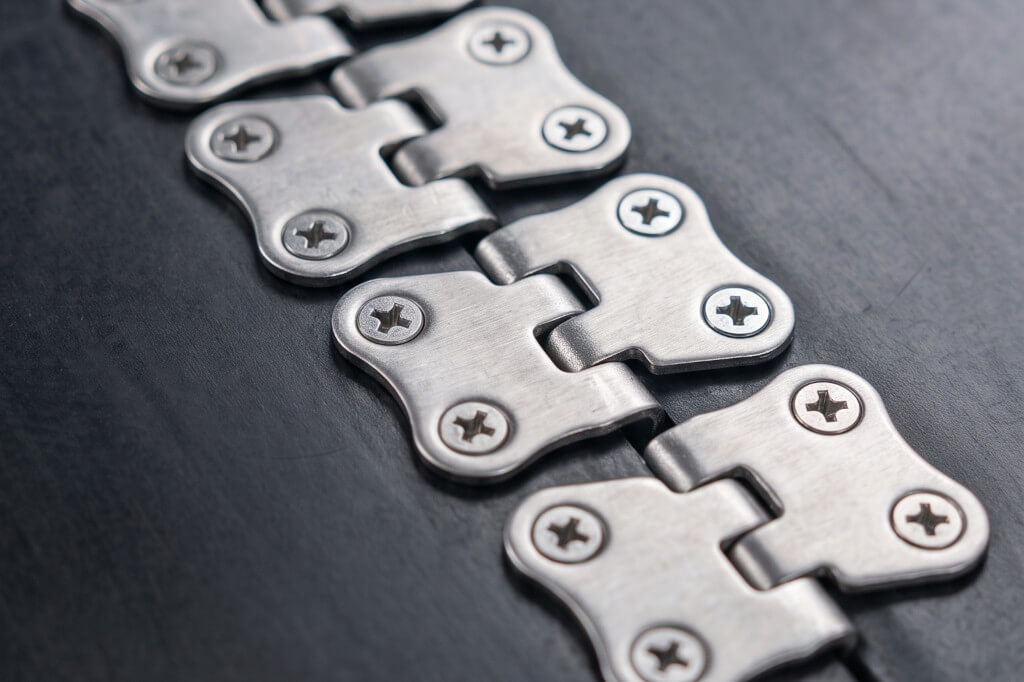
1. Immediate Restart with action-ready mechanical fasteners
Breakdowns don’t give warning, but the solution can already be in your hands. When a belt breaks, time is measured in thousands of euros lost every hour.
A rubber conveyor belt can be engineered to allow quick mechanical splicing right on site. You don’t have to wait for an external specialized technician to arrive or endure the lengthy process of hot vulcanization: your own team can reconnect the belt and get the plant running again.
It is the technical assurance that turns a business-halting emergency into a simple hiccup resolved in minutes.
2. Less friction on rollers, greater net savings on energy bills
Process and energy consumption optimization often comes down to small details.
For instance, while the top surface of the belt—the visible side supporting the material—delivers technical performance, the bottom side—invisible because it contacts the machinery—can be engineered with a special fabric impression finish that drastically reduces the coefficient of friction as it slides.
Alternatively, low-friction rollers or dedicated sensors can be used to adjust speed based on load and weight.
These are all targeted strategies that reduce motor strain, minimize machinery wear, and ultimately cut energy consumption.

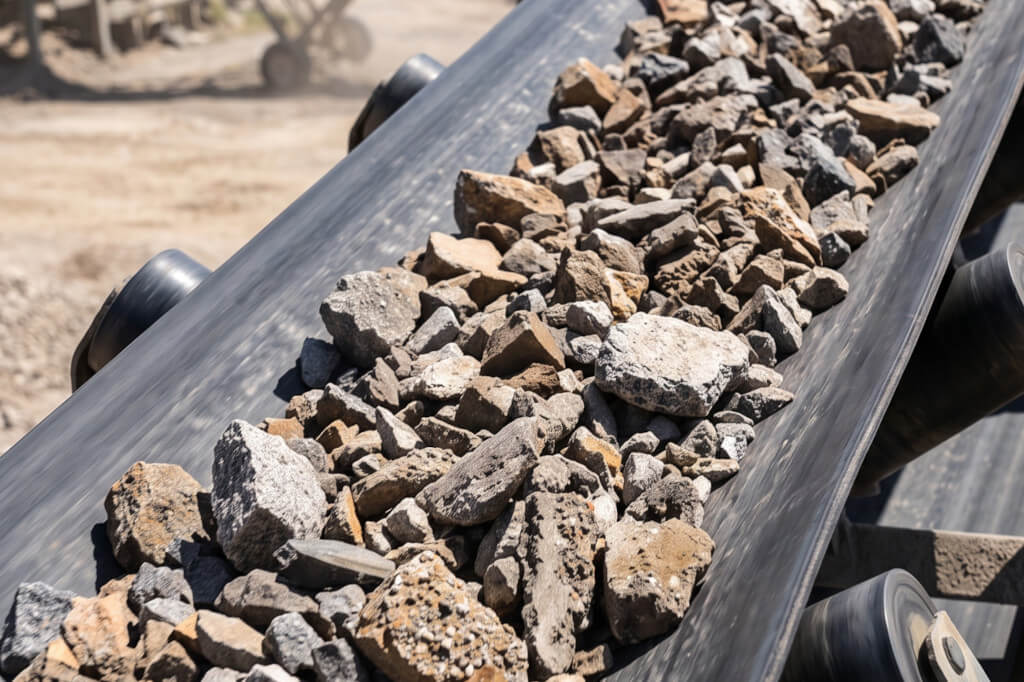
3. Non-swelling rubber that resists the sharpest and most abrasive materials
Standard rubber coming into contact with animal or vegetable fats and mineral oils rapidly deforms and frays in a short time.
Selecting the right compound makes the belt chemically stable, allowing it to convey sharp and abrasive materials such as metal scrap and rubble, as well as various other products.
Furthermore, a smooth compound compatible with belt scraper systems enables you to remove wet, oily, or sticky material residues on the very first pass.
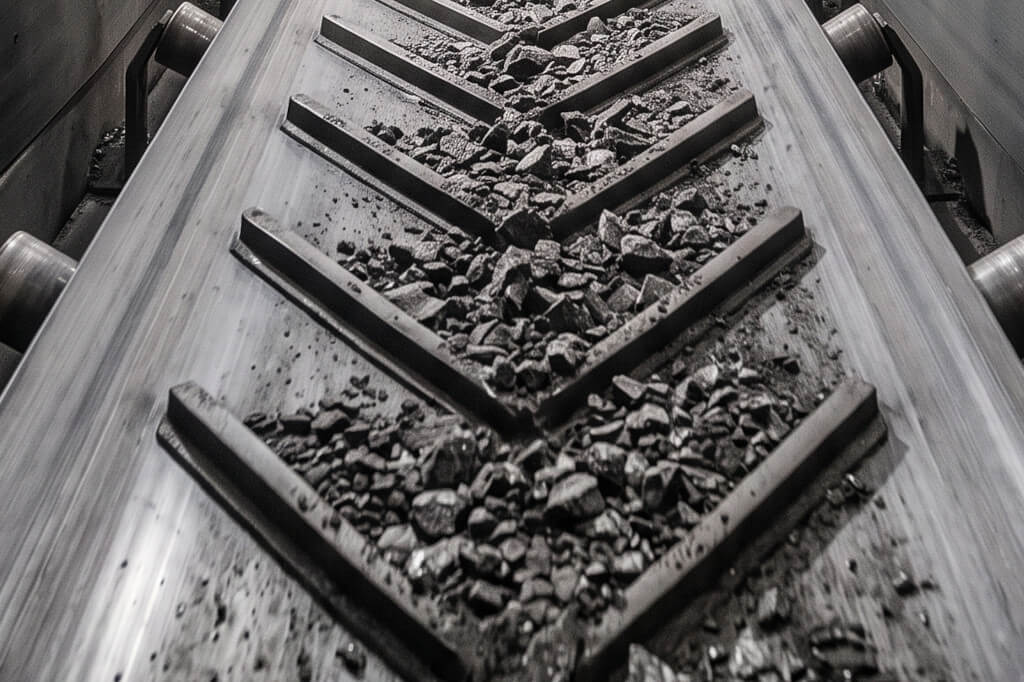
4. Steep inclines and high speeds, without load rollback
If you need to move bulk materials or packaged goods along inclined sections, gravity is your biggest enemy.
Selecting a belt with chevron patterns and integrated cleats molded and vulcanized as a single piece with the top cover is an ideal solution.
This configuration ensures an iron grip on the load even at steep inclination angles, eliminating bottlenecks and allowing your automated lines to run at full capacity.
Criteria for finding the best rubber conveyor belt: How to find the most suitable one?
Even though rubber conveyor belts are among the most widely available equipment on the market, evaluating them for your operations involves many factors to consider and several questions to answer.
The wide range of available solutions can make it challenging to choose the right equipment to boost your performance when doubts arise.
Below is a list of key questions and factors to explore to help you find the right equipment for your needs:
- What is a rubber conveyor belt? Discover specifically what type of equipment it is!
- What types of belting are available for a rubber conveyor belt? Discover the types of rubber and their features here!
- What are the differences between a rubber conveyor belt and a PVC conveyor belt? Find out if it’s the right fit for you here!
- How do you properly maintain a rubber conveyor belt? Discover how to do it and its benefits here!
What a rubber conveyor belt is: purpose and applications
A rubber conveyor belt is a mechanical equipment designed to move materials, goods, or raw materials continuously, efficiently, and safely within a production cycle.
It consists of textile or metallic carcass inserts coated with layers of high-strength rubber and is typically used to transport heavy loads over challenging, long, inclined routes or under severe environmental conditions.
It is primarily used in industrial, logistics, mining, and agricultural sectors where robust, durable machinery is required to optimize production and processing times while increasing material transfer speed.
Which type of belting to choose for a rubber conveyor belt: processes and features
When evaluating the purchase of a rubber conveyor belt for your business and operations, choosing the right rubber belting is critical.
Several factors must be assessed, including the compound type and the required belting characteristics based on the specific material it contacts.
The main types of rubber used are:
- NR Natural Rubber: ideal for heavy loads and high impacts at ambient temperatures, offering good elasticity and high resistance to tearing and cutting.
- SBR Styrene-Butadiene Rubber: the most widely used compound in industrial applications, featuring excellent resistance to abrasion and wear.
- NBR Nitrile Rubber: a solution specifically developed to withstand prolonged and continuous contact with hydrocarbons, solvents, mineral oils, and vegetable fats.
- EPDM Rubber: the most commonly used rubber for transporting high-temperature materials up to and over 200°C, offering excellent ozone resistance.
- CR Neoprene / Chloroprene Rubber: the material of choice when self-extinguishing or flame-retardant properties are required, offering good overall resistance to mild chemicals and weathering.
- Silicone and FKM / Viton Fluoroelastomer Rubber: specialized compounds used in specific industrial niches for transporting highly aggressive substances, sticky materials, or handling extreme temperatures.
In practice, the use of these rubber compounds translates into specific performance characteristics for the conveyor belt, which are the main factors to focus on:
- Abrasion and cut-resistant rubber belting: Ideal for resisting friction damage from heavy, sharp materials such as stone, gravel, and minerals; primarily made from NR natural rubber or SBR styrene-butadiene rubber.
- Oil and grease-resistant rubber belting: The perfect solution to prevent cover degradation or swelling when transporting oily or chemically aggressive materials; primarily made from NBR nitrile rubber.
- Heat-resistant rubber belting: The top choice when enduring high temperatures up to and over 200°C for conveying foundry slag, ash, or cement clinker; primarily made from EPDM rubber.
- Flame-retardant rubber belting: Mandatory in environments with explosion and ATEX risks, tunnels, or underground mines; primarily made from CR neoprene rubber.
- Cleated or chevron rubber belting: Features molded or vulcanized rubber cleats and profiles on the surface, making them suitable for transporting materials along inclined sections without slippage.
Advantages of a rubber conveyor belt: How it compares to PVC
The choice between a rubber conveyor belt and a PVC conveyor belt is predominantly driven by the type of facility, the materials being handled, and the working environment.
While both types of equipment fulfill the need for continuous material handling in practice, they differ in physical and mechanical characteristics as outlined below.
Here are the key advantages and differences between the two solutions compared:
- Strength & Durability: Rubber belting is an ideal choice if you need a solution that withstands abrasion, violent impacts, and cuts when handling heavy loads and aggressive materials. Conversely, PVC is better suited for medium loads and is less resistant when subjected to severe impacts.
- Working Environment: Rubber is the preferred solution for outdoor working environments such as quarries, construction sites, building projects, or the mining industry. On the other hand, PVC is more commonly used indoors in logistics and sorting facilities, packaging lines, and assembly operations.
- Operating Temperature: The temperature range the conveyor belt must endure dictates the choice of one material over another, as they perform very differently. Rubber offers a broader operational and functional range, enduring both extreme cold and very high temperatures (ranging from -30°C with specialized compounds up to over 200°C with others), whereas PVC operates within narrower limits, roughly from -10°C to 80°C.
- Hygiene & Food Contact: PVC is superior in this regard, as it features smooth, non-porous surfaces suitable for direct food contact and is easy to sanitize, disinfect, and clean. Rubber, by contrast, requires special food-grade compounds (such as nitrile) and is less widely used in this sector.
- Energy Consumption: Rubber conveyor belts are heavier and more robust, requiring larger drive systems that tend to consume more power. In contrast, PVC belts are lighter and more flexible, allowing them to operate with smaller pulleys and reduce the motor’s energy consumption.
Maintenance tasks for a rubber conveyor belt: How to prevent operational downtime
Consistently taking care of a rubber conveyor belt is the best way to extend the equipment’s service life and avoid costly downtime.
To do this effectively, simply separate daily tasks from periodic, schedulable maintenance, organizing the workflow to take advantage of low-load periods.
Below is a list of the main maintenance tasks along with their recommended frequency:
- Daily Checks: recommended actions to perform at the start and end of work shifts
- Visual Inspection of the Rubber Surface: check for cuts, abrasions, cracks, or signs of premature wear on the edges and across the belt, as well as foreign objects caught in components.
- Belt Alignment Check: verify that the belt runs perfectly centered on the rollers under both loaded and unloaded conditions. Misalignment or incorrect tension causes the belt to rub against metal structures, leading to damage.
- Noise and Vibration Inspection: abnormal noises coming from rollers or motor bearings indicate a component is not functioning properly; early intervention lets you schedule downtime on your terms.
- Quick Scraper Inspection and Cleaning: ensure that surface cleaning systems are clear and free from material buildup. It is good practice to clean them at the start or end of a shift, depending on your operational schedule.
- Weekly Checks: more thorough cleaning and adjustment activities
- Cleaning Rollers, Drums, and Loading Zones: remove caked-up material sticking to the rollers beneath the belt and drums. Additionally, clear any buildup in loading zones or hoppers to prevent clogging and friction.
- Belt Tension Verification: check that the belt is properly tensioned. If too loose, the belt may slip—burning the underside or causing material spillage; if too tight, it overstrains motor components, risking unexpected failure or breakage.
- Skirtboard Inspection: inspect side skirtboards for hardening or damage. Worn skirts can leak material laterally or trap sharp objects that act like blades, carving grooves into the belting.
- Monthly Checks: schedulable routine tasks designed to keep equipment running at peak performance
- Bearing and Support Lubrication: grease rotating mechanical parts such as drive drums and primary rollers.
- Scraper System Adjustment: adjust blade pressure and replace worn inserts as needed.
- Belt Splice Inspection: perform a detailed visual check at the splice joint to detect early signs of bond failure or separation.
- Bi-Annual / Annual Checks: general system overhaul and preventive overhaul procedures
- Roller Replacement: schedule the replacement of seized, noisy, or worn rollers with new components.
- Belt Cover Thickness Measurement: measure rubber thickness to assess overall wear and plan belt replacement before structural failure occurs.
- Motor and Reducer Inspection: check oil levels and inspect the overall condition of the drive system components.